Answer Engine Optimization (AEO): How to Get Cited by ChatGPT and Perplexity in 2026

SynthOperator Systems Team
AEO Strategy Lead
Released
July 20, 2026
Duration
10 min read
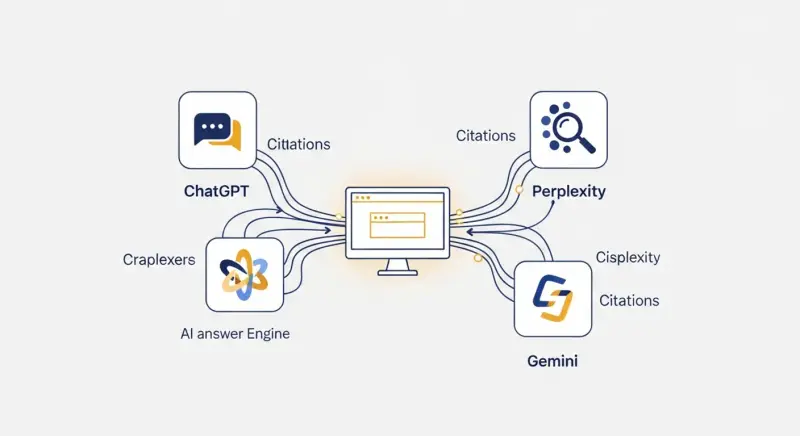
Google traffic is declining. AI answer engines are the new search. Learn how to optimize your content for ChatGPT, Perplexity, and Gemini citations with a complete AEO system.
// Key_Takeaways
- ▹ Google traffic dropped from 60% to below 40% — AI answer engines (ChatGPT, Perplexity, Gemini) are the new search.
- ▹ AEO optimizes for three pillars: Entity Authority, RAG-Optimized Content Structure, and Citation Potential.
- ▹ Featured images alone are insufficient — in-body images boost views by 94% according to 2026 research.
- ▹ TL;DR at top, question-based H2s, FAQ schema, and expanded author bios are essential for AI citation.
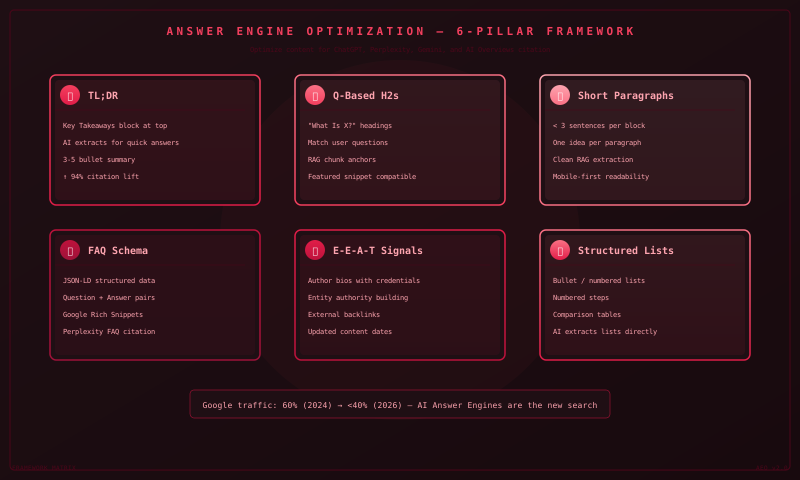
- ▹ The 6-pillar AEO framework: TL;DR, Q-Based H2s, Short Paragraphs, FAQ Schema, E-E-A-T, and Structured Lists.
01
Index_Structure
↓
Index_Structure
The Shift from Search to Answers
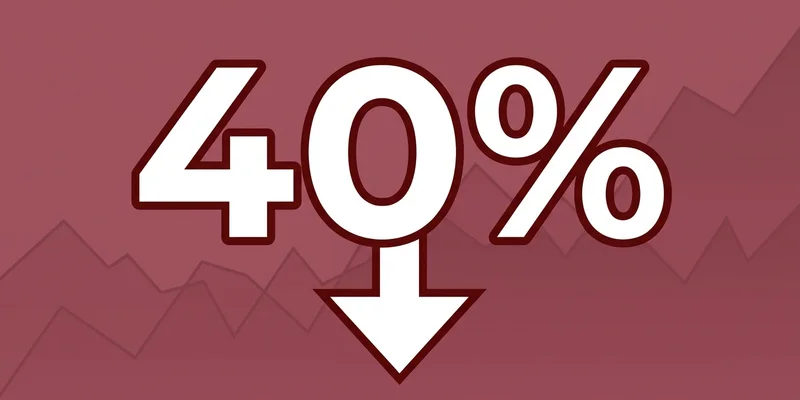
In 2024, Google drove 60% of web traffic. In 2026, that number is below 40% and falling. The difference? ChatGPT, Perplexity, and Gemini now answer millions of queries per day — and users are getting their answers without ever clicking a search result.
This is the Answer Engine era. And it requires a new discipline: Answer Engine Optimization (AEO).
What Is AEO?
AEO is the practice of optimizing content so that AI models cite it as a primary source when answering user questions. Unlike traditional SEO, which optimizes for a search engine’s ranking algorithm, AEO optimizes for:
- Entity Authority: Does the AI recognize your brand as an expert source?
- Semantic Density: Is your content structured for RAG (Retrieval-Augmented Generation)?
- Citation Potential: Would an AI model trust your content enough to cite it?
The Three Pillars of AEO
1. Entity Authority
AI models don’t rank pages — they rank entities. Your brand, your authors, and your content are all entities that AI models evaluate for authority.
Building entity authority requires:
- Structured data markup: Schema.org entities that clearly define who you are and what you know
- Consistent citations: Being referenced by other authoritative sources in your niche
- Author expertise signals: Clear author bios, credentials, and publication history
This is why our Claude Skills framework includes AEO-specific skill files — they ensure every piece of content you produce reinforces your entity authority.
2. RAG-Optimized Content Structure
When an AI like ChatGPT needs to answer a question, it uses RAG to retrieve relevant chunks of text. Content that is structured for RAG extraction gets cited more often.
Key principles:
- Clear topic boundaries: Each section should cover one discrete topic
- Descriptive headings: Headings that contain the exact questions users ask
- Summary paragraphs: Opening paragraphs that encapsulate the section’s key point
- List structures: Bullet points and numbered lists are highly extractable
3. Technical AEO Infrastructure
Beyond content, there are technical signals that tell AI crawlers your site is authoritative:
- llms.txt files: A standardized file that tells AI crawlers your site structure and priority pages. Our n8n llms.txt Auto-Generator turns this setup into a 30-second automated process.
- AI crawler accessibility: Ensuring GPTBot, GeminiBot, and PerplexityBot can access your content
- Citation trail: Clear references and sources that AI models can follow

The 90-Day AEO Blueprint
Weeks 1-2: Audit and Structure
Run an AEO readiness audit on your top 10 pages. Score each page on semantic density, entity clarity, and citation potential. The AEO 2026 Bundle includes a RAG Auditor prompt that scores any page out of 100.
Weeks 3-4: Content Restructuring
Rewrite your top pages for RAG extraction. Clear headings, summary paragraphs, structured data. Deploy Claude Skills for consistent content formatting.
Weeks 5-8: Authority Building
Publish pillar content on your primary topics. Build internal links between related pages. Get cited by other authoritative sources. Monitor who AI is citing in your niche using the n8n AEO Monitor workflow.
Weeks 9-12: Monitor and Iterate
Track your brand mentions in AI responses. Identify gaps where AI is citing competitors instead of you. Iterate on content structure and authority signals.
AEO vs. SEO: Not a Replacement, an Extension
AEO doesn’t replace SEO — it extends it. The same content that ranks on Google can be optimized for AI citations with structural changes. The key difference is in how you frame expertise: SEO optimizes for keywords, while AEO optimizes for entities and authority.
For a complete technical system covering the playbook, n8n workflows, and Claude skills, see the AI AEO 2026 Bundle.
The Bottom Line
The agencies that win the next decade won’t be the ones that rank highest on Google. They’ll be the ones that AI trusts as sources. Answer Engine Optimization is the infrastructure for that trust.
For a complete agency automation framework combining AEO with traffic generation and workflow orchestration, explore our AI Agency Automation Guide.
Pair AEO with automated Pinterest traffic and n8n workflows for a full-stack visibility and growth system.
Ready to get cited by AI? Get the AEO 2026 Bundle.
From the Vault
// About_the_Author
SynthOperator Systems Team
AEO Strategy Lead
Specializing in answer engine optimization, entity authority, and AI citation strategies.