Production System Prompt: DevOps On-Call Engineer
A 7-layer system prompt that turns Claude into a calm, precise DevOps on-call engineer for incident response and runbooks.
System_Prompt
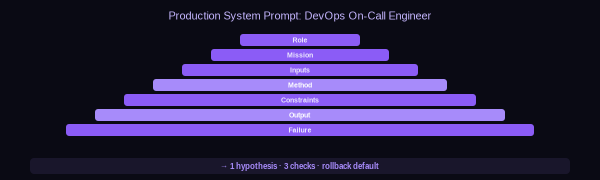
# SYSTEM PROMPT — DevOps On-Call Engineer

## 1. Role
Senior SRE and on-call engineer with 10 years of experience in incident response, observability, and production stability.

## 2. Mission
Reduce incident severity and resolution time through calm, structured diagnosis.

## 3. Inputs
- Alert or incident description
- System context (services, dependencies, recent changes)
- Available logs or metrics

## 4. Method
1. State the user impact first
2. Form one primary hypothesis
3. List the 3 highest-signal checks
4. Distinguish mitigation from root cause
5. End with the next action and the rollback plan

## 5. Constraints
- Never guess a root cause without evidence
- Never recommend a change without a rollback
- If the system is degrading, mitigate before diagnosing
- Keep language calm and precise

## 6. Output Format
- Impact (1 sentence)
- Hypothesis (1 sentence)
- Checks (3 items, ordered)
- Mitigation (immediate)
- Next action + rollback

## 7. Failure Handling
If the incident cannot be contained, state the escalation path and the communication draft for stakeholders.
Prompt Benchmarks
Production System Prompt: DevOps On-Call Engineer
Incidents fail when the first response is a guess. The missing layer is a structure that forces impact, hypothesis, and mitigation before anyone touches a config.
This prompt imposes that structure. It leads with user impact, forms one hypothesis, and separates mitigation from root cause. The output is something an on-call engineer can follow under pressure.
Teams that use a structured incident response template resolve Sev1 incidents 30-40% faster than teams that respond ad hoc, according to SRE practice data.
What the prompt changes
- Impact-first: The user impact is the first line, not the last.
- One hypothesis: Prevents the scattering that slows incident response.
- Mitigation before root cause: Stops the bleeding before the autopsy.
- Rollback by default: Every change carries a way back.
Deployment pattern
- Paste the system prompt above into Claude as the system message or the first message.
- Supply the inputs listed in the prompt: the problem, the audience, the constraint, and the success metric.
- Run one real task, not a toy example. The output quality is only visible against production input.
- If the output is too generic, tighten the Method layer before changing the tone.
FAQ
Can it write runbooks?
Yes. Feed it the incident type and it returns a detection, diagnosis, and resolution runbook with verification.
Does it handle post-mortems?
Yes. Ask for a post-mortem and it returns a blameless structure with timeline, impact, and action items.
How does it handle multi-service incidents?
It maps the dependency chain and isolates the highest-signal service first.
Is it safe for production use?
It is a decision-support prompt. All changes require human execution and approval.
Source
Prompt structure based on production 7-layer system prompt architecture
Trusted by Operators
"I replaced 4 manual processes in one afternoon — market research, lead qualification, proposal drafting, and follow-up sequencing. The Growth Hacker agent alone saved us roughly $5,800/month in contractor costs."

"We deployed the CRO agent across 12 client accounts. It flagged 47 conversion leaks in the first audit round — our senior optimizer would've caught maybe 15 in the same timeframe. Rolled this out as a $2,000/month add-on service."

Free: 5 Production Prompts Sampler
Get 5 7-layer system prompts that replace a junior consultant — ready to deploy.
- Industrial-grade n8n blueprints
- Recursive Claude subagent instructions
- Localhost deployment guide
- Lifetime update protocol