What AEO Tactics Actually Move Citation Rates in 2026? (Data-Backed Blueprint)

SynthOperator Systems Team
AEO Strategy Lead
Released
October 1, 2026
Duration
12 min read
Most AEO advice is noise. Here are the 7 tactics with actual measurement behind them — ranked by real impact on AI citation rates, with the data, the implementation steps, and the mistakes that cancel them out.
// Key_Takeaways
- ▹ Third-party mentions move citation rates 6.5x more than your own content — listicles, reviews, and comparisons are the highest-leverage AEO asset in 2026.
- ▹ The 7 tactics ranked by measured impact: third-party citations, proof pages, entity consistency, YouTube mentions, llms.txt (for non-Google engines), technical eligibility, and direct-answer formatting.
- ▹ Technical eligibility is the floor: if a page is not indexed and snippet-eligible in classic Google Search, it cannot appear in AI Overviews or AI Mode — no AEO tactic overrides that.
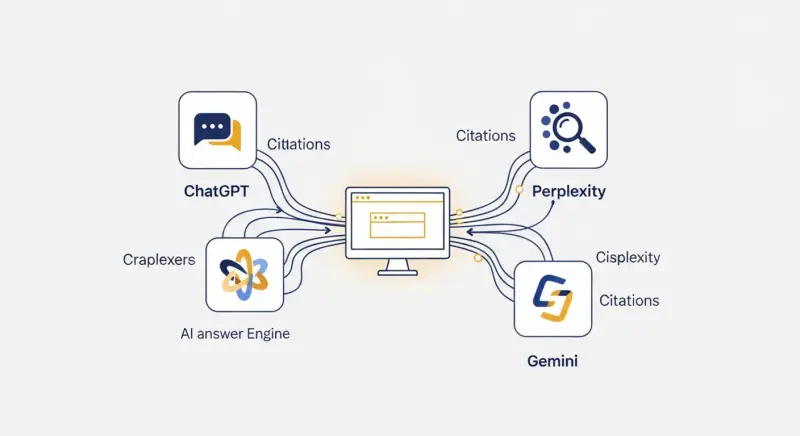
- ▹ Measure citations per query, weekly, in ChatGPT, Perplexity, Gemini, and AI Mode — not impressions. A citation is a citation regardless of the surface.
01
Index_Structure
↓
Index_Structure
The Direct Answer
What actually moves AI citation rates in 2026 comes down to seven tactics, in this order: third-party mentions (6.5x more effective than your own content), a dedicated proof page, entity consistency across sources, YouTube mentions, clean technical eligibility (indexing plus schema), llms.txt for non-Google engines, and direct-answer formatting on every target page. Everything else is decoration. The data below shows why each one works, how to deploy it, and the specific mistake that silently cancels each tactic.
The 7 Tactics, Ranked by Measured Impact
Before the deep dive, here is the full ranking. Impact is based on 2026 research from Ahrefs, SE Ranking, Airops, and controlled practitioner experiments. That is the same body of work we broke down in our underrated AEO tactics guide and our complete AEO system.
| # | Tactic | Measured Impact | Effort | Time to Show |
|---|---|---|---|---|
| 1 | Third-party listicles & reviews | 6.5x citation lift vs own domain | High | 4-12 weeks |
| 2 | Dedicated proof / LLM info page | 2-3x on brand queries | Low | 2-4 weeks |
| 3 | Entity consistency (NAP, positioning) | Compounding, 4-12 weeks | Medium | 4-12 weeks |
| 4 | YouTube mentions | Strongest correlation with AI visibility (2026 Ahrefs study) | Medium | 4-8 weeks |
| 5 | Technical eligibility + structured data | Floor requirement (0 if absent) | Low | 1-2 weeks |
| 6 | llms.txt | Optional; non-Google engines only | Low | 2-6 weeks |
| 7 | Direct-answer formatting (TL;DR, question H2s) | +15-30% on eligible pages | Medium | 2-4 weeks |
Read that table twice. The tactic with the biggest number is the one most agencies ignore, because it is not on their website.
#1: Third-Party Citations — the 6.5x Lever
Why it works: When an AI engine retrieves sources for a query, it weighs consensus across independent sources. A model that finds your brand described the same way on five unrelated domains treats that description as grounded fact. A model that finds it only on your own site treats it as self-promotion.
The 2026 Ahrefs AEO study put a number on this: brands are 6.5x more likely to be cited through third-party sources than their own domains. The highest-leverage formats are listicles (“best X tools”), comparison pages, and category roundups: the exact pages that aggregate your niche.
The implementation protocol:
- Map the aggregator landscape. Search your niche in ChatGPT and Perplexity with “best [category] tools”. Screenshot every source cited. That list is your prospect list. Those domains are already the ones AI engines trust for your queries.
- Audit your presence on each. Are you listed? Is the description accurate? Is it stale?
- Fix, then add. Correct stale entries first (highest ROI: you’re editing, not creating). Then pursue listings where you’re absent: directory submissions, partner pages, “we use” pages, and guest contributions.
- Control the description. Third-party pages that repeat your exact positioning line (“[brand] + category + differentiator”) are compounding assets. Every consistent repetition hardens the entity.
The mistake that cancels it: inconsistent positioning. If your homepage says “AI automation for agencies”, your LinkedIn says “marketing tech”, and your directory listings say “web services”, the model resolves the conflict by not citing anyone. Entity consistency is not a separate tactic. It is the multiplier applied to this one.
#2: The Proof Page — Your Identity Block
AI models will find information about your company somewhere. If you don’t provide a clean version, they improvise from noisy third-party data, which may be outdated or include competitors.
A proof page (sometimes called an LLM info page) is a single, permanent URL that tells AI systems:
- Who you are, what you do, who it’s for
- Your exact positioning line, repeated verbatim
- Founder and team credentials (named people, not “our team”)
- Key facts you want cited: numbers, launch dates, capabilities
We call it an identity block that is impossible to misread. Link it from your footer, your sitemap, and, if you ship one, your llms.txt.
The implementation protocol:
- Write the page as an answer to the question “What is [brand]?”: one page, 600-900 words, no marketing fog.
- Use a
Personschema for the founder andOrganizationschema for the brand, both with matchingsameAsURLs. - Keep the positioning line byte-identical to the one on your homepage and social profiles.
- Run the page through our free Open Graph Checker before shipping. AI engines and social crawlers read those metadata tags first, and a missing
og:descriptionquietly degrades how the page gets summarized.
The mistake that cancels it: a proof page that nobody can find. If it’s a hidden internal page with no footer link and no internal links pointing to it, retrieval probability drops to near zero.
#3: Entity Consistency — the Silent Multiplier
Google’s Knowledge Graph and LLM retrieval both build entity graphs from repeated, consistent mentions. The fields that matter:
- Name: exact, everywhere (no “SynthOp” on one directory and “SynthOperator AI” on another)
- Category: same positioning language
- URLs: one canonical domain; old domains must 301, never soft-redirect
- People: founder name, role, and LinkedIn identical across site, YouTube, and directories
How to audit in an afternoon:
- List every place your brand appears: site, social profiles, app stores, directories, GitHub org, YouTube, podcast appearances.
- Export the name/category/URL triple for each.
- Diff them. Anything that differs is a fix.
This is unglamorous and it is the cheapest compounding asset in AEO. One hour of cleanup multiplies the effectiveness of every other tactic on this list.
#4: YouTube — the Correlation Nobody Expected
The 2026 Ahrefs study found YouTube mentions show the strongest correlation with AI visibility across ChatGPT, AI Overviews, and AI Mode, stronger than blog content in the same niche.
Why: YouTube transcripts are densely indexed, timestamped, and attributed to named speakers. For AI engines, a 20-minute interview where the founder explains the product with specific numbers is a high-trust, entity-rich source, exactly the shape RAG systems prefer.
The minimum viable video protocol:
- One 10-20 minute interview or walkthrough per quarter.
- The founder speaks (named attribution beats voiceover).
- State the positioning line verbatim at least twice.
- Include specific, citable numbers: “we process X, it takes Y seconds, it costs Z.”
- Caption the video and keep the description structured (what it is, who it’s for, one link).
You do not need a channel. You need one video that answers “what is [brand]?” better than anything else the model can retrieve.
#5: Technical Eligibility — the Floor
Google’s official AI optimization guidance is blunt: to be eligible for generative AI features, a page must be indexed and eligible to appear in Google Search with a snippet. No AEO content tactic can lift a page that fails this floor.
The checklist:
- Page indexed (not
noindex, not blocked in robots.txt) - Fetchable by Googlebot, and by GPTBot, PerplexityBot, and GeminiBot if you want non-Google citations
- Valid
ArticleorBlogPostingschema with author, dates, and absolute image URLs - Complete Open Graph tags with a 1200x630 image
- No rendering that depends on JavaScript the crawler won’t execute
The audit that takes 10 minutes: paste your URL into the free Open Graph Checker. It validates the tag set, image dimensions, and JSON-LD blocks that make or break the floor. If the floor is broken, stop doing content tactics and fix the page.
#6: llms.txt — Optional, Not Obligatory
Here is where most AEO content gets it wrong: it treats llms.txt as a ranking lever. It isn’t.
Google’s official position (May 2026): “You don’t need to create new machine readable files, AI text files, markup, or Markdown to appear in generative AI search.” Anthropic, OpenAI, and Perplexity have not published a requirement either.
That said, the file costs you nothing and helps two things: it gives crawlers a prioritized map of your site structure, and it works as a soft signal for engines that do consume it. If you ship one:
# SynthOperator

> AI automation systems, free tools, and agency infrastructure.

## Tools
- [Prompt Compressor](https://synthoperator.com/tools/prompt-compressor/): Compress LLM context windows
- [Open Graph Checker](https://synthoperator.com/tools/open-graph-checker/): Audit social metadata

## Guides
- [AEO Guide](https://synthoperator.com/blog/answer-engine-optimization-aeo-guide/)
- [n8n Automation Blueprint](https://synthoperator.com/blog/n8n-automation-blueprint-2026/)
Keep it under 100 lines, keep it accurate, and stop thinking about it. It is infrastructure, not a tactic.
#7: Direct-Answer Formatting — the On-Page Lever
This is the only tactic on the list that is 100% inside your control, which is why teams over-invest in it. It matters, but it multiplies the other six. It doesn’t replace them.
The four rules:
- A 40-60 word direct answer in the first paragraph of every target page, answering the query verbatim.
- Question-based H2s that mirror how users ask (“How long does it take…?”, “What is…?”).
- One table or list per major claim: structured data extracts better than prose.
- A 4-question FAQ at the bottom with
FAQPageschema, answering the follow-up questions users actually ask.
Pro move for content pipelines: when you’re generating drafts at scale, the opening paragraph is where most models produce a 120-word fog of throat-clearing. Run the first paragraph through our free Prompt Compressor. It trims to the direct-answer budget without dropping the claim, which is exactly the shape AI engines lift.
The mistake that cancels it: direct-answer formatting on pages that fail the eligibility floor (tactic #5). A perfect TL;DR on a noindex page is a perfect TL;DR nobody reads.
The Measurement Protocol (How You’ll Know It Worked)
Impressions lie. Rankings lie more. Citations are the KPI.
The weekly 20-minute protocol:
- Maintain a spreadsheet of 20-30 questions pulled from your real Search Console queries (the long-tail, question-shaped ones).
- Every Monday, ask each question in four surfaces: ChatGPT, Perplexity, Gemini, and Google AI Mode.
- Log: was your domain cited? By which surface? What source URL was shown?
- Compute citation share: your citations ÷ total citations for that question.
- Chart citation share per question and in aggregate, weekly.
Expected shape: on-site tactics (proof page, formatting, schema) move the needle within 2-4 weeks. Off-site tactics (mentions, YouTube, consistency) lag 4-12 weeks, then compound. If nothing moves after 8 weeks, the problem is almost always the eligibility floor or entity consistency, not your content.
The 30-Day Deployment Plan
| Week | On-site | Off-site |
|---|---|---|
| 1 | Eligibility floor audit (Open Graph Checker, robots, schema) + proof page live | Export your 30-question measurement set; baseline all 4 surfaces |
| 2 | Direct-answer formatting on top 10 pages | Map the aggregator landscape; list every source AI cites for your niche |
| 3 | FAQ schema on top 10 pages; entity consistency audit started | Fix stale third-party listings; submit to 5 missing directories |
| 4 | llms.txt shipped; measurement re-run | Pitch 3 listicle/comparison inclusions; book the quarterly video |
By day 30 you will know, with data not vibes, which of the seven tactics your niche actually rewards. Most niches show a clear #1 within the first measurement cycle.
The Bottom Line
AEO in 2026 is not a content strategy. It is an evidence strategy: you are building the set of independent, consistent, retrievable sources that AI engines can treat as grounded fact. Third-party mentions do 6.5x the work of your own site, technical eligibility is the floor, and direct-answer formatting is the multiplier on top.
Start with the floor. Build the proof page. Then go get mentioned.
Want the full system: the RAG auditor prompt, the n8n citation monitor workflow, and the Claude skill files that enforce this structure on every page you publish? Get the AEO 2026 Bundle.
// FREE_TOOL
Free Tool: Open Graph & Metadata Checker
Every citation starts with a page AI engines can parse. Audit your Open Graph tags, JSON-LD, and rich snippets in 30 seconds — free, no signup.
Try the Free Tool →// Frequently_Asked_Questions
What is the single highest-impact AEO tactic in 2026? ↓
Getting cited on third-party pages. Research tracked by Ahrefs in 2026 found brands are 6.5x more likely to be cited through third-party sources than their own domains. A single listicle or review mention in your niche can outperform a month of on-site optimization.
Do I need an llms.txt file to be cited by AI? ↓
No. Google's official guidance states that llms.txt files are not required for generative AI features, and there is no special AI-specific schema. That said, llms.txt remains a low-cost signal for non-Google engines and helps crawlers understand site structure — treat it as optional infrastructure, not a ranking lever.
How long does it take for AEO tactics to move citation rates? ↓
On-site tactics (proof pages, direct-answer formatting, schema) typically show citation movement within 2-4 weeks of deployment. Off-site tactics (third-party mentions, YouTube, entity consistency) compound slower — 4-12 weeks — but produce the durable gains.
How do I measure whether AEO tactics are working? ↓
Build a 20-30 question set from your real search console queries, ask each one in ChatGPT, Perplexity, Gemini, and Google AI Mode on a fixed schedule (weekly), and log which sources get cited. Track your domain's citation share per question over time — that number, not traffic, is the AEO KPI.
// About_the_Author
SynthOperator Systems Team
AEO Strategy Lead
Specializing in answer engine optimization, entity authority, and AI citation strategies.