AI Content vs Human: Burstiness, Perplexity, and the Heuristics Detectors Actually Use

SynthOperator Systems Team
Content Quality Engineer
Released
October 2, 2026
Duration
13 min read
How AI content detectors really work — the two statistics under the hood (perplexity and burstiness), the documented pattern heuristics, the math of false positives, and what 'undetected' should and should not mean for a publishing workflow.
// Key_Takeaways
- ▹ Modern detectors run on two statistics: perplexity (how surprising each word is to a language model) and burstiness (how much sentence structure varies) — machine text is too predictable and too regular on both axes.
- ▹ The pattern heuristics layer adds documented tells: significance inflation, AI vocabulary, flat parallel structure, circling paragraphs — a checklist a model (or a reader) can run in parallel with the statistics.
- ▹ False positives are structural, not accidental: excellent human writing is low-perplexity and sometimes low-burstiness, so detectors flag real writers at 10-20% rates on their best days — a '0% AI' score is a property of the detector, not a certificate on the text.
- ▹ The usable definition of 'human' is the measured one: burstiness in the human distribution, perplexity above the machine floor, pattern flags cleared, voice matching a real sample — verifiable with the same heuristics the detectors use, before anything ships.
01
Index_Structure
↓
Index_Structure
The Direct Answer
AI detectors are two statistics plus a pattern checklist: perplexity (how predictable the words are: machine text is too predictable), burstiness (how much sentence structure varies: machine text is too regular), and a layer of documented tells (inflation, AI vocabulary, flat structure, circling). Their false positives are structural. Excellent human writing sits inside the machine distribution, which is why 10-20% flag rates on clean corpora are normal. The usable goal is not a score; it is a measured state: text in the human distribution on the axes the detectors actually compute, verified before it ships.
The Two Statistics Under the Hood
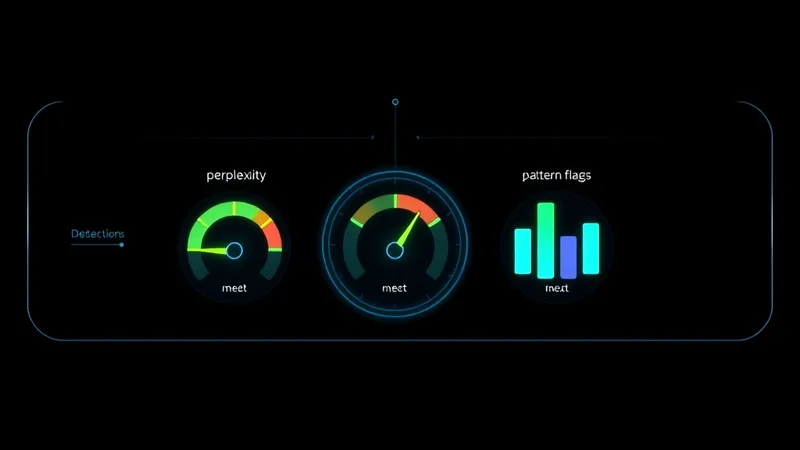
Every serious detector is a classifier trained on the same two signals. Understanding them is understanding the whole system.
Perplexity: The Predictability Axis
Perplexity is a property of a language model evaluating text: for each word, it asks “how surprising was this choice?” Machine-generated text is, by construction, a sequence of high-probability choices. The model that wrote it picked the likely next word, again and again. The result: machine text has low perplexity. It is too smooth.
Human writing is different in a specific, measurable way. Humans make low-probability choices constantly:
- Specific nouns where a generic one fits (“the cron job that bills clients” vs “the background process”)
- Odd-but-true adjectives (“a 2am null check”: the 2am is irrelevant to the logic and essential to the voice)
- Mid-thought pivots that a probability distribution would smooth away (“But the billing failure at 9am hits differently than at 3pm”: a human sentence, not a generated one)
Each of these choices raises the text’s perplexity under any evaluator model. So the detector’s perplexity axis is really measuring: how often does this writer choose the surprising word?
Burstiness: The Rhythm Axis
Burstiness measures the variance in sentence structure across a passage. The signature is in the numbers:
| Signature | Machine text | Human text |
|---|---|---|
| Sentence lengths | 22, 19, 24, 21, 23 (low variance) | 7, 31, 4, 42, 18 (high variance) |
| Paragraph openers | The / This / In / It (repeating shapes) | Varied: verb-start, fragment, name, question |
| List density | Three parallel bullets, every section | A list where needed, prose where not |
| Punctuation habits | Even, consistent | Idiosyncratic (and that idiosyncrasy is the signal) |
The statistic that captures this is essentially the variance of sentence length (sometimes weighted by structural diversity). The ten-line version:
import statistics

def burstiness(text):
    sentences = [s for s in text.replace('\n', ' ').split('. ') if s.strip()]
    lengths = [len(s.split()) for s in sentences]
    if len(lengths) < 3:
        return 0.0
    return statistics.pstdev(lengths) / max(statistics.mean(lengths), 1)

# machine text typically lands 0.3-0.6
# human writing typically lands 0.8-1.5+
Machine text averages out. The generation process smooths variance. Human text spikes. A writer lands a short sentence on purpose, then lets the next one run.
Key point: both axes point the same direction: machine text is the average of itself. It is predictably predictable and regularly regular. Human text is a specific person’s irregularity. Irregularity, in this system, is the fingerprint.
The Pattern Heuristics Layer
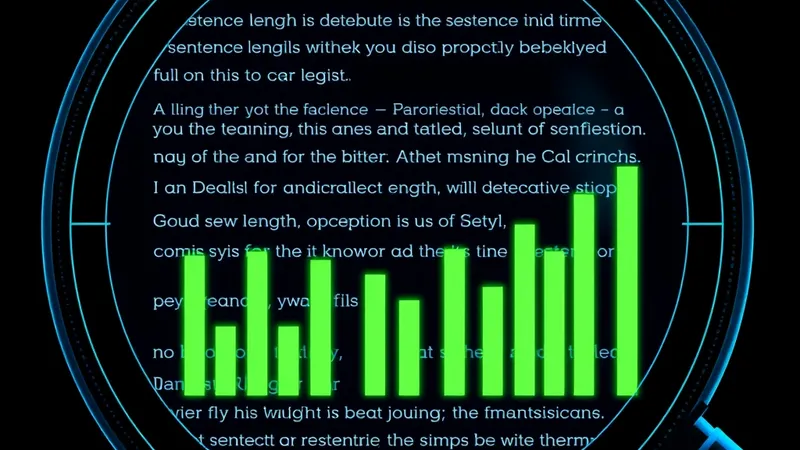
Statistics catch the distribution; heuristics catch the content. On top of the two axes, detectors (and any sharp reader) run a checklist. The public reference is the 33-pattern library documented in Wikipedia’s WikiProject AI Cleanup; the five that carry most detection weight:
1. Significance inflation. “Marking a pivotal moment in the evolution of…”, “a testament to the power of…”, “in an era of unprecedented change.” Human writing states facts without announcing their importance; generated writing narrates its own importance.
2. AI vocabulary clusters. Individually harmless: delve, tapestry, landscape, showcase, leverage, utilize, foster, furthermore, thus. In a paragraph, unmistakable. The detector doesn’t need all of them; two or three in 200 words is a flag.
3. Structural tells. Mechanical parallel lists in every section, title-case headings in body text, em-dash overuse, the “X: Y. Z: W.” colon rhythm throughout. These are formatting habits the generation process converges on.
4. Circling. The paragraph that describes the topic from four angles and lands on none. Generated text summarizes; human text asserts. A section that ends without a claim is a section the detector (and the reader) remembers.
5. Uniform confidence. Every sentence carrying the same weight, the same hedge level, the same temperature. Human writing modulates. A bold claim, then a careful one, then a throwaway. Generated writing is one temperature from first line to last.
The heuristics layer is what makes detectors explainable. The score you get comes with “why,” and the why is this checklist. It is also, critically, the layer a humanizer works on: you can fix a flagged paragraph by addressing the specific patterns, which is why pattern-aware editing outperforms “make it sound more natural” every time.
Warning: the heuristics are bidirectional. The same features that flag AI text (over-regularity, over-confidence, inflation) are also the features of bad human writing. A detector flagging your text is, often, a reader previewing their experience. Treat a flag as a quality signal first and a detection signal second; the two mostly agree.
The False Positive Problem (The Math of Being Flagged)
The overlap between the human and machine distributions is not a bug to be patched; it’s the geometry of the problem.
Where humans live inside the machine distribution:
- Technical and legal prose is naturally low-perplexity (controlled vocabulary, constrained syntax), exactly the machine signature.
- Terse, competent writing is sometimes low-burstiness (a skilled editor’s uniform clarity looks like a generator’s uniform smoothness).
- Non-native English that is careful and correct can read “too smooth” to a model trained on native variety.
The consequence, in numbers: published studies and vendor documentation converge on 10-20% false-positive rates on clean human corpora for the best commercial detectors. That is not a failure mode. It is the operating point. A detector that flagged no good human writing would also miss most machine text, because the two distributions share the territory where good writing lives.
What this means operationally:
- A “0% AI” score is a detector property, not a text certificate. It means this text sat far enough outside the machine distribution for this model, this day. A different detector, or a model update next quarter, moves the boundary.
- A “100% AI” score on human text is expected noise. The correct response to a false positive is not to rewrite the text into something less good. It is to know the number’s confidence interval.
- The only stable goal is the distribution, not the score. Text that is structurally human (irregular rhythm, specific words, asserted claims, a real voice) will sit in the human distribution under any detector, because it actually is human-shaped. Chasing a number chases a moving target; building the shape builds an asset.
| Question | Score-chasing answer | Distribution answer |
|---|---|---|
| Will this pass? | Maybe — the boundary moved | Yes — the shape is human |
| What do I fix? | The flagged words | The flagged patterns (and the quality they indicate) |
| Does it survive a new detector? | Unknown | Yes — detectors measure shape |
| What’s the byproduct? | Slightly worse text | Better text (the fixes are quality fixes) |
The Measurement Protocol (Run It Before You Publish)
The protocol treats the detector’s own axes as a quality gate: the same heuristics, used offensively, before anything ships:
1. Baseline the two statistics. Run the text through a scorer that reports perplexity (or its proxy: predicted-word agreement) and burstiness (sentence-length variance). You now have numbers, not vibes.
2. Run the pattern checklist. The five-heuristic pass, paragraph by paragraph: inflation, vocabulary clusters, structural tells, circling, uniform confidence. Log every hit with its location.
3. Compare against a human reference. The strongest single control: score your own known-human sample (a past article, a real email thread) with the same scorer. Your text’s statistics should sit in the same neighborhood as your known-human writing. If your “AI-assisted” paragraph is smoother than your best human work, it is telling on itself.
4. Fix the pattern hits, re-measure. Address the flagged patterns specifically: cut the inflation, break the parallel lists, insert the short sentence, land the claim. Re-run the scorer. The burstiness delta is your proof the rewrite changed the shape, not just the words.
5. Gate on the distribution, not the score. The publish gate: burstiness within your known-human band, perplexity above the machine floor, zero pattern hits in the top two paragraphs (where readers and crawlers look first). The detector’s single percentage is logged for trend, not used as the gate.
The free AI Content Detector runs steps 1-2 in seconds, in the browser (burstiness, vocabulary repetition, structural tells), which makes it the practical entry point to the protocol and the cheapest quality gate in a content pipeline.
The Ethics Line (State It in the Workflow)
The measurement discipline above is a quality tool, and the line for using it is clear:
- Humanizing your own drafts (improving the rhythm, specificity, and voice of content you authored and verified) is normal editorial work, the same category as line editing. The fixes the protocol produces are quality fixes; a paragraph that asserts, varies, and sounds like a person is a better paragraph whether or not a detector scores it.
- Laundering unverified generated content into “human journalism” is a different activity, and no amount of burstiness makes it defensible. The claims in the text have to be yours, researched, and accurate. The voice is not the substance.
- EU context: the AI Act’s Article 50 transparency obligations (applicable from August 2026) concern AI-generated content presented as such. They regulate disclosure of AI generation, not the editing of human-authored material. If your pipeline genuinely produces AI-generated content that you publish, the disclosure question is a legal one to settle before the measurement question, not after.
The workflow rule that keeps the line clean: the human owns the claims, the protocol owns the voice. If a step in your pipeline skips the first ownership, no measurement downstream rescues it.
Pro tip: keep a 10-paragraph “voice sample” per author in the pipeline (real writing, pulled with permission) and run the scorer’s reference comparison (step 3) against it per article. It converts “does this sound human?” into “does this sound like this person?”, which is the actual publishing standard, and it makes the detector’s percentage a footnote.
The Bottom Line
Detectors are not mind-readers; they are distribution classifiers measuring two statistics (predictability, regularity) and one checklist (the tells). Their false positives are the geometry, not the glitch. So the productive relationship with detection is not evasion. It is measurement: know the axes, run the heuristics on yourself, compare against your known-human voice, fix the patterns (which are quality bugs anyway), and gate on the shape of the text rather than the shadow it casts. A text that is structurally human passes every detector, because it is the thing the detectors are built to distinguish. It reads better for the humans who never see a score.
The full protocol as a publishing gate (the scorer, the pattern library, the voice-sample comparison, wired into the content pipeline) ships inside the Humanizer and the skill files in the Claude AI Skills Pack v2. For the rewriting side of the same system, read The Claude Humanizer Guide and the original AI Humanizer 33-Pattern breakdown; for the detection-adjacent SEO side, see What AEO Tactics Actually Move Citation Rates.
// FREE_TOOL
Free Tool: AI Content Detector
Score any text on burstiness, vocabulary repetition, and structural tells in seconds — the same heuristics the detectors use, before you publish.
Try the Free Tool →// Frequently_Asked_Questions
What are burstiness and perplexity in AI detection? ↓
Perplexity measures how predictable each word is to a language model: machine text chooses the most likely next word over and over, so its perplexity is low; human writing contains more low-probability choices (specific nouns, odd-but-true adjectives, mid-thought pivots), so its perplexity is higher. Burstiness measures variation in sentence length and structure: machine text averages out (20, 22, 19 words), human text spikes (a 4-word sentence, then a 40-word one, then a fragment). Both are computed over the text as a whole, not word by word.
Why do AI detectors flag good human writing? ↓
Because the statistics don't measure 'human' — they measure distance from the machine distribution, and the human distribution overlaps it. Technical writing, legal prose, and terse copy are naturally low-perplexity and sometimes low-burstiness, which is exactly the machine signature. Published studies and vendor admissions put false-positive rates at 10-20% on clean human corpora; a flagged paragraph is a hypothesis, not a verdict.
Can any text reliably score 0% AI? ↓
No detector can certify that, and anyone selling a 'guaranteed 0%' is selling the detector's output, not the text's quality. What you can do is move the text into the human distribution on the measurable axes — burstiness up, perplexity up, pattern flags cleared, voice calibrated to a real sample — and verify it with the same heuristics pre-publish. That is a quality property; the score is its shadow.
What heuristics do detectors use besides the two statistics? ↓
A pattern layer on top of the statistics: significance inflation ('marking a pivotal moment', 'a testament to'), AI vocabulary clusters (delve, tapestry, landscape, leverage, furthermore), structural tells (mechanical parallel lists, em-dash overuse, three-sentence uniform paragraphs), and circling (describing a topic from several angles without landing on a claim). The documented 33-pattern library from Wikipedia's AI cleanup effort is the public reference; commercial detectors use similar private checklists.
// About_the_Author
SynthOperator Systems Team
Content Quality Engineer
Specializing in AI content quality, readability optimization, and natural language engineering.