ScrapingBee Alternative: Local Ad Research Without API Credits
Stop burning ScrapingBee credits on Meta ads. A local n8n scraper + Claude AI analyzer costs $7.99 once and runs without usage meters.
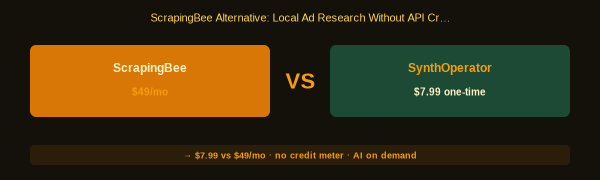
ScrapingBee vs SynthOperator
| Feature | ScrapingBee ($49/mo) | SynthOperator ($7.99 / one-time) |
|---|---|---|
| Billing model | Monthly credits; overage at usage rates | $7.99 one-time; pay only for optional Claude analysis |
| Request anxiety | Every scrape consumes an API credit | Local fetches are unlimited on your hardware |
| Analysis layer | Returns HTML/JSON; no built-in AI insights | Claude extracts hook, CTA, and psychological angle |
| Data retention | You must export or lose it | SQLite table with advertiser, ad, and analysis columns |
| Offline review | Requires platform access | Query the local database anytime |
| Team access | Seat or API key management | Share the SQLite file or connect Sheets |
ScrapingBee Alternative: Local Ad Research Without API Credits
API credit systems create a strange behavior: you start rationing your own research. Before you check a competitor’s new creative, you ask whether the request is worth 5 credits.
The local Meta Ads Scraper removes that micro-decision. The workflow pulls from the Ads Library on your schedule, writes to SQLite, and triggers Claude only when you want a deep analysis. The scraper itself is free to run; the AI layer is metered by tokens, not by scraping credits.
ScrapingBee’s $49/month plan includes 5,000 API requests. A single competitor campaign with 200 ad variants plus 50 landing pages can consume a third of that allowance before your team has read a single insight.
Where the decision actually lives
The comparison table isolates the variables that change the decision. The price is the entry point, but the operating model is what compounds: local data, one-time ownership, and analysis applied only where it creates value. SynthOperator at $7.99 one-time is built for the focused workflow, not the general-purpose infrastructure contract.
Why operators switch
- No credit rationing: Research volume is limited by your hardware and Meta’s public interface, not by a monthly counter.
- Analysis where it matters: Claude is applied to the ads worth understanding, not to every raw request.
- Portable research: SQLite survives platform shutdowns, pricing changes, and laptop upgrades.
- Simple cost model: One fixed tool cost plus transparent token usage when you run AI reviews.
The six variables that matter
- Billing model: Monthly credits; overage at usage rates → $7.99 one-time; pay only for optional Claude analysis
- Request anxiety: Every scrape consumes an API credit → Local fetches are unlimited on your hardware
- Analysis layer: Returns HTML/JSON; no built-in AI insights → Claude extracts hook, CTA, and psychological angle
FAQ
Is ScrapingBee overkill for ads research?
If your workflow is 100% Meta Ads Library, yes. It shines when you need rendered pages, proxies, and multi-site coverage.
How do I avoid rate limits locally?
The workflow includes a pacing node. You set requests per minute; the default is conservative enough for research use.
Can I keep historical ad versions?
Yes. Each scrape run appends a timestamped row, so you can diff creative changes over time.
What if I need JavaScript rendering?
For Ads Library pages, static parsing usually works. If a target needs rendering, add a local headless browser node — still without a per-request cloud fee.
Source
Local scraping + LLM analysis pattern from public n8n automation libraries (MIT)
Trusted by Operators
"I cancelled my $149/mo spy tool subscription within 10 minutes of running this template. We now track all 5 of our main competitors hourly for just $4.50 in Claude API costs. The hook analysis is shockingly deep!"

"Deploying this on our n8n instance was a breeze. We scrape competitor ad variations and automatically push the markdown reports into our Slack channel. Our creative designers are in love with it."

Free: Competitor Pricing Calculator
See exactly how much you're overpaying vs. what you could save with SynthOperator.
- Industrial-grade n8n blueprints
- Recursive Claude subagent instructions
- Localhost deployment guide
- Lifetime update protocol