ScrapFly Alternative: Self-Hosted Proxy and Playwright Stack
ScrapFly provides managed scraping infrastructure. The self-hosted Playwright, proxy, and n8n stack gives you a local scraping pipeline with explicit cost control.
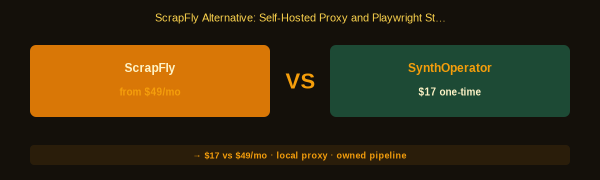
ScrapFly vs SynthOperator
| Feature | ScrapFly (from $49/mo) | SynthOperator ($17 / one-time) |
|---|---|---|
| Pricing | Managed subscription plus usage | $17 one-time stack |
| Proxies | Included proxy network | Your proxy provider or local egress |
| Rendering | Managed browser | Local Playwright browser |
| Parsing | Managed extraction | Custom selectors and code |
| Data control | Cloud processed | Local storage |
| Ops ownership | Vendor-managed | Self-managed |
ScrapFly Alternative: Self-Hosted Proxy and Playwright Stack
Managed scraping platforms sell reliability. Self-hosted scraping sells control.
ScrapFly is built to remove the hard parts of scraping: proxies, rendering, parsing, and uptime. If those parts are already inside your stack, a self-hosted Playwright and n8n workflow can deliver the same pipeline with a much smaller recurring cost.
Managed scraping pricing usually bundles rendering, proxy rotation, and parsing into one per-page or plan fee, so the cost becomes visible once the workflow processes large result sets.
Where the decision actually lives
The right choice depends on how much scraping ops you want to own. If you want the vendor to handle proxies and uptime, a managed platform makes sense. If you want the pipeline inside your infrastructure, self-hosting is the better operating model.
Why operators switch
- Explicit costs: Proxy, server, and storage costs are separate line items.
- Custom extraction: You can tune selectors per domain without platform limits.
- Data locality: Raw pages and normalized records stay in your stack.
- Workflow portability: The n8n pipeline can move between servers without vendor migration.
The six variables that matter
- Pricing: Managed subscription plus usage → $17 one-time stack
- Proxies: Included proxy network → Your proxy provider or local egress
- Rendering: Managed browser → Local Playwright browser
FAQ
Do I need premium proxies?
For many targets, residential or mobile proxies help. The workflow lets you plug in the provider you already trust.
Is it reliable for large crawls?
Yes, if you add retries, rate limiting, and monitoring. The tradeoff is that you own those controls.
Can it replace ScrapFly parsing?
For structured extraction, yes. You write or maintain the selectors and normalization logic.
When is ScrapFly better?
When you want managed proxies, uptime, and parsing with minimal infrastructure work.
Extend the stack
- JSON/CSV Converter — Normalize exports before local ingestion.
- AI Model Comparator — Benchmark local vs hosted model tradeoffs.
- n8n Automation OS — Import the self-hosted workflow stack.
Source
Scraping pipeline patterns verified against Playwright and n8n HTTP/browser workflow references (Apache-2.0 / MIT)
Trusted by Operators
"Deployed the full OS across 7 client accounts in week one. The 27K template library meant I stopped building workflows from scratch — I search, import, configure credentials, and deploy. Estimated 80+ hours/month saved in workflow development alone. The 15 AI agents replaced $12K/month in contractor overhead."

"The infrastructure architecture is production-grade. I've run 15,000+ workflow executions over 90 days with zero critical failures. The error-handling patterns (retry logic, dead-letter queues, Slack alerting) are already wired in. I spent 3 years building similar tooling in-house — this saved me 6+ months of engineering."

Free: Competitor Pricing Calculator
See exactly how much you're overpaying vs. what you could save with SynthOperator.
- Industrial-grade n8n blueprints
- Recursive Claude subagent instructions
- Localhost deployment guide
- Lifetime update protocol