Oxylabs Alternative: Self-Hosted Ads Scraper Without Datacenter Fees
If you only need Meta competitor ads, skip $119/month Oxylabs. Deploy a local Meta Ads Scraper + Claude AI pipeline for $7.99 one-time.
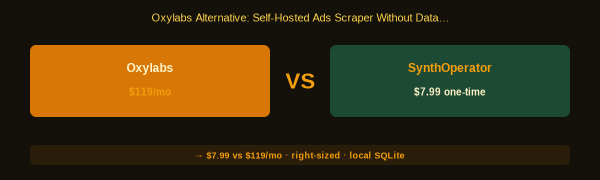
Oxylabs vs SynthOperator
| Feature | Oxylabs ($119/mo) | SynthOperator ($7.99 / one-time) |
|---|---|---|
| Entry cost | $119/month for starter proxy volume | $7.99 one-time |
| Use-case fit | General-purpose web and ad scraping | Purpose-built Meta Ads research loop |
| Analysis | Data extraction only | Claude AI creative breakdown per ad |
| Storage | Platform storage or your own export | Local SQLite, version-controlled schema |
| Privacy | Requests pass through third-party infrastructure | Runs on your machine; no data resale surface |
| Scaling | Pay more for more proxies | Scale by adding cheap Claude API calls |
Oxylabs Alternative: Self-Hosted Ads Scraper Without Datacenter Fees
Oxylabs sells reliability. You should pay for reliability when reliability is the product. When the product is ad research, the reliability you actually need is in the parser and the analysis layer.
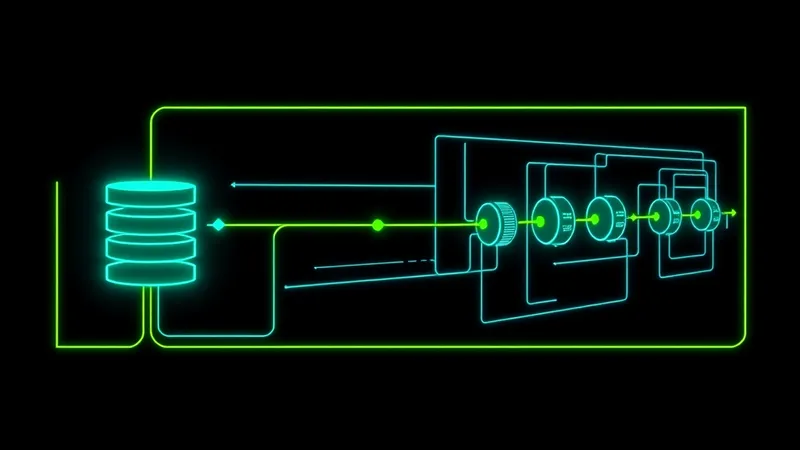
This page is for teams that looked at Oxylabs for competitor tracking and realized the invoice would outgrow the insight. The local stack pulls the Meta Ads Library, normalizes the rows, stores them in SQLite, and lets Claude flag the creative patterns worth stealing — without a datacenter subscription.
A typical growth team tracks 50–200 competitor ads per month. On Oxylabs, that habit starts at $119/month before a single insight is generated. The local pipeline turns the same volume into structured notes for under $10 in AI analysis per month.
Where the decision actually lives
The comparison table isolates the variables that change the decision. The price is the entry point, but the operating model is what compounds: local data, one-time ownership, and analysis applied only where it creates value. SynthOperator at $7.99 one-time is built for the focused workflow, not the general-purpose infrastructure contract.
Why operators switch
- Right-sized infrastructure: You pay for the job — ad research — not for a global proxy mesh you will mostly idle.
- Structured output: Every ad becomes a row with hook, CTA, visual notes, and a Claude-generated angle summary.
- Local control: The database is on your disk. Back it up, query it, or delete it without a support ticket.
- Predictable cost: The tool cost is fixed. The only variable is how many Claude analyses you run.
The six variables that matter
- Entry cost: $119/month for starter proxy volume → $7.99 one-time
- Use-case fit: General-purpose web and ad scraping → Purpose-built Meta Ads research loop
- Analysis: Data extraction only → Claude AI creative breakdown per ad
FAQ
Is Oxylabs better for large-scale scraping?
For large-scale, multi-domain crawling, yes. The comparison here is narrow: Meta competitor ad research where a local pipeline is sufficient.
What if Meta changes the Ads Library layout?
The workflow isolates the parsing node. When the layout changes, you update one node — you do not renegotiate a proxy contract.
Can I export to my existing BI stack?
Yes. SQLite can be read by DuckDB, BigQuery, Sheets, or a simple CSV export into any warehouse.
Does the tool store my ad data in the cloud?
No. The default is a local SQLite file. Cloud sync is optional and only if you connect a Sheets or Slack node.
Source
Local scraper + Claude analysis pattern from public n8n workflow examples (MIT)
Trusted by Operators
"I cancelled my $149/mo spy tool subscription within 10 minutes of running this template. We now track all 5 of our main competitors hourly for just $4.50 in Claude API costs. The hook analysis is shockingly deep!"

"Deploying this on our n8n instance was a breeze. We scrape competitor ad variations and automatically push the markdown reports into our Slack channel. Our creative designers are in love with it."

Free: Competitor Pricing Calculator
See exactly how much you're overpaying vs. what you could save with SynthOperator.
- Industrial-grade n8n blueprints
- Recursive Claude subagent instructions
- Localhost deployment guide
- Lifetime update protocol