Browserbase Alternative: Local Playwright Browser Infrastructure at $17
Browserbase sells hosted browser sessions. A self-hosted Playwright plus n8n stack gives you local browser infrastructure for predictable scraping workflows.
Browserbase vs SynthOperator
| Feature | Browserbase (usage-based) | SynthOperator ($17 / one-time) |
|---|---|---|
| Billing | Usage-based sessions | $17 one-time stack |
| Infrastructure | Hosted browser cloud | Local or VPS Playwright |
| Session control | Platform-managed | Full local control |
| Data path | Cloud session | Local capture and storage |
| Concurrency | Plan or usage limits | Bound only by your server |
| Ops burden | Lower | You own the browser host |
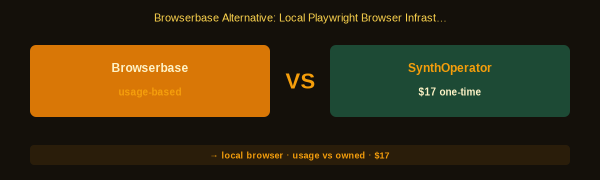

Browserbase Alternative: Local Playwright Browser Infrastructure at $17
Hosted browser platforms make sessions easy until the session count becomes the pricing model.
For many scraping and automation workflows, the browser is just infrastructure. Running Playwright on your own machine or VPS gives you the same rendering, waiting, and extraction behavior without a per-session cloud dependency.
Browser session pricing matters most when workflows run long pages, retries, or parallel captures, because each retry can become another billable unit.
Where the decision actually lives
If your browser workload is steady, internal, and data-sensitive, self-hosting is the cleaner model. If you need burst capacity without managing servers, a hosted browser platform can be worth the usage fee.
Why operators switch
- Predictable cost: The workflow cost is fixed; the server cost is separate and visible.
- Local data path: Pages are captured where your database already lives.
- Full browser control: Contexts, proxies, timeouts, and retries are yours to configure.
- No session lock-in: The workflow can move between machines without platform migration.
The six variables that matter
- Billing: Usage-based sessions → $17 one-time stack
- Infrastructure: Hosted browser cloud → Local or VPS Playwright
- Session control: Platform-managed → Full local control
FAQ
Do I need a GPU?
No. Headless Playwright runs well on a normal CPU VPS for most scraping workloads.
Can I run parallel browsers?
Yes, but tune concurrency to CPU and memory limits to avoid crashes.
What about mobile emulation?
Playwright supports device descriptors, so mobile viewports are available locally.
When is Browserbase better?
When you need managed scale, distributed sessions, or zero browser maintenance.
Extend the stack
- JSON/CSV Converter — Normalize exports before local ingestion.
- AI Model Comparator — Benchmark local vs hosted model tradeoffs.
- n8n Automation OS — Import the self-hosted workflow stack.
Source
Playwright browser session patterns verified against microsoft/playwright (Apache-2.0)
Trusted by Operators
"Deployed the full OS across 7 client accounts in week one. The 27K template library meant I stopped building workflows from scratch — I search, import, configure credentials, and deploy. Estimated 80+ hours/month saved in workflow development alone. The 15 AI agents replaced $12K/month in contractor overhead."

"The infrastructure architecture is production-grade. I've run 15,000+ workflow executions over 90 days with zero critical failures. The error-handling patterns (retry logic, dead-letter queues, Slack alerting) are already wired in. I spent 3 years building similar tooling in-house — this saved me 6+ months of engineering."

Free: Competitor Pricing Calculator
See exactly how much you're overpaying vs. what you could save with SynthOperator.
- Industrial-grade n8n blueprints
- Recursive Claude subagent instructions
- Localhost deployment guide
- Lifetime update protocol