API Contract Guardian Agent — Breaking Change Prevention
Deploy an API Contract Guardian Agent that watches OpenAPI changes, classifies breaking risk, generates regression tests, and blocks unsafe merges in CI.
Performance Benchmarks
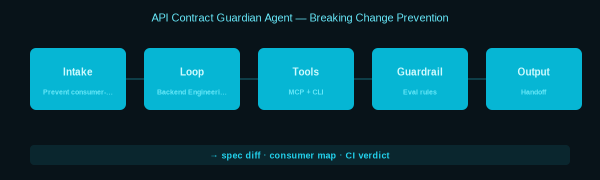
API Contract Guardian Agent — Breaking Change Prevention
The API contract is the promise. The agent protects the promise.
The API Contract Guardian Agent watches the spec, not just the code. It classifies changes, maps consumer impact, and gives CI a clean verdict before a breaking change can merge.
Contract regressions are cheapest to catch when the spec diff and the generated regression test run in the same pull request, before downstream clients discover the break.
Multi-Turn Operating Loop
- PR Watch — Detect changes to OpenAPI files or generated SDK surfaces.
- Contract Diff — Classify additive, compatible, and breaking changes.
- Consumer Impact — Map the change to affected endpoints, SDK methods, and clients.
- Test Generation — Create regression tests for each risky consumer surface.
- CI Verdict — Return a merge decision with the exact failing contract.
Reference Architecture
The agent sits between the spec and CI. It does not modify the API implementation directly; it generates the evidence needed to approve or block the change. A deterministic OpenAPI diff runs first, and the agent explains the result in consumer terms.
Deployment CLI
npx openapi-diff openapi/v1.yaml openapi/v2.yaml
claude -p "Use the api-contract-guardian agent to review this OpenAPI diff"
npm run test:api
Reference Configuration
{
  "name": "api-contract-guardian",
  "description": "Prevents breaking API changes using OpenAPI diffs and generated tests.",
  "tools": ["Read", "Grep", "Bash"],
  "model": "sonnet"
}
MCP Wiring
{
  "mcpServers": {
    "github": {
      "command": "npx",
      "args": ["-y", "@modelcontextprotocol/server-github"]
    }
  }
}
Guardrails & Evaluation Rules
- Spec is truth: The OpenAPI document defines the contract, not the implementation comment.
- Consumer lens: Every finding must name the consumer surface affected.
- No silent suppression: Intentional breaking changes must be labeled, not hidden.
- Merge gate: CI receives a pass/fail verdict, not just advisory prose.
What the agent changes
- Early break detection: Contract issues surface at PR time, not in production.
- Consumer-aware reports: Findings are framed around the client impact.
- Regression coverage: Risky changes come with generated tests.
- CI integration: The output is shaped for pipeline gates.
FAQ
Does it support GraphQL?
It is optimized for OpenAPI. GraphQL can use a schema diff adapter with the same contract-guardian rules.
Can it block a PR?
It returns the merge verdict. The CI job decides whether to enforce the block.
What about versioned APIs?
It compares the correct major or minor spec version based on the route prefix or version field.
Does it write client SDKs?
It does not regenerate SDKs, but it flags when a spec change will alter generated client behavior.
Extend the stack
- Prompt Compressor — Keep agent system prompts under context budget.
- Context Window Visualizer — Map where tokens go across sessions and MCP calls.
- Claude Agents Pro — Deploy full agent systems with guardrails.
Source
API guard patterns sourced from public OpenAPI diff, contract testing, and GitHub PR automation references (MIT / Apache-2.0)
Trusted by Operators
"I replaced 4 manual processes in one afternoon — market research, lead qualification, proposal drafting, and follow-up sequencing. The Growth Hacker agent alone saved us roughly $5,800/month in contractor costs."

"We deployed the CRO agent across 12 client accounts. It flagged 47 conversion leaks in the first audit round — our senior optimizer would've caught maybe 15 in the same timeframe. Rolled this out as a $2,000/month add-on service."

Free: Agent ROI Calculator
Calculate how many hours our agents save your team — enter task volume, see weekly time savings.
- Industrial-grade n8n blueprints
- Recursive Claude subagent instructions
- Localhost deployment guide
- Lifetime update protocol